The 5 Best Stocky Alternatives for Shopify in 2026
By Canopy Team

Quick answer
The best Stocky alternatives for Shopify in 2026 are Canopy (best for brands with large SKU counts and long supply chains), Prediko (best for DTC brands wanting clean forecasting), Fabrikator (best for simple reorder automation), Cin7 (best for multi-channel enterprise), and Linnworks (best for marketplace sellers). Each has different strengths — the right choice depends on your SKU count, supplier complexity, and budget. Canopy is the only one built specifically around weeks cover as the core metric.
Why you need to choose a Stocky replacement now
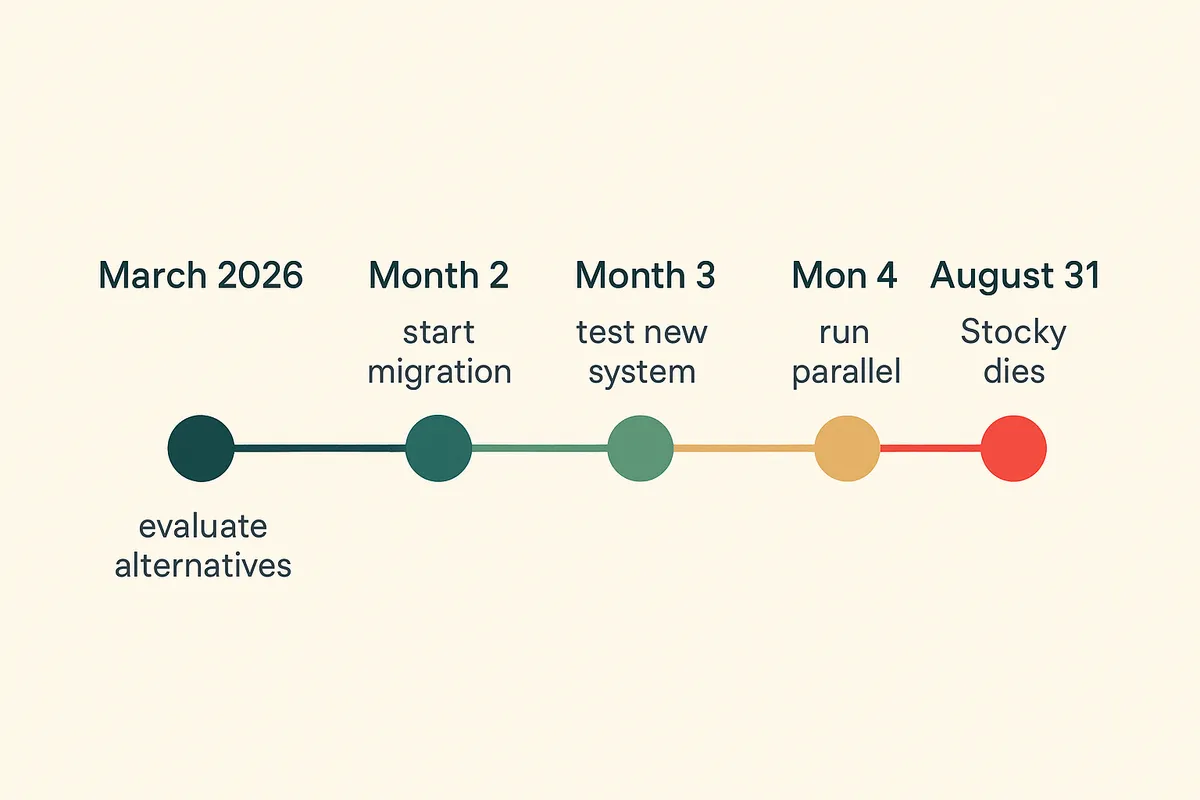
Shopify is shutting down Stocky on 31 August 2026. That is not a soft deprecation or a feature freeze — the app will be fully removed from every Shopify store. Your purchase orders, supplier data, and demand forecasting history inside Stocky will become inaccessible. If you are still using Stocky in March 2026, you have roughly five months to evaluate alternatives, migrate your data, and run parallel systems before the deadline. The merchants who start now will have a smooth transition. The ones who wait until July will be scrambling.
What Stocky actually did (and what it couldn't)
Before comparing alternatives, it is worth being honest about what Stocky was. It handled purchase order creation, basic supplier management, and rudimentary demand forecasting. It was free, bundled with Shopify, and it worked — up to a point. What Stocky could not do: calculate weeks cover, model supplier lead times into reorder suggestions, handle multi-location inventory intelligently, track landed costs, or identify dead stock proactively. Most merchants used perhaps 20% of its features — mainly creating POs. If that describes you, any of the five alternatives below will be an upgrade. If you need more than basic PO management, the differences between these tools matter significantly.
1. Canopy — best for brands with large SKU counts and long supply chains
Canopy is built specifically for Shopify brands that have outgrown spreadsheets and basic inventory apps. It uses weeks cover as its core metric, which means every SKU shows you how many weeks of stock you have left based on actual sales velocity — not just a quantity number. Key features include supplier lead time modelling (critical for brands sourcing from China with 120+ day lead times), dead stock identification, landed cost tracking, barcode scanning via phone camera, and purchase order management with goods receiving. Canopy is designed for founders and ops managers, not inventory specialists. The interface is deliberately simple: traffic-light colour coding shows you what needs attention without requiring you to interpret complex dashboards. Pricing starts lower than most competitors, with no per-SKU charges that punish growth. Currently accepting waitlist sign-ups with early access pricing locked in for founding members.

2. Prediko — best for DTC brands wanting clean demand forecasting
Prediko has the most polished interface of any Shopify inventory app. It was built by ex-Deliveroo data scientists and the design sensibility shows. Demand forecasting is its standout feature — it uses machine learning models that account for seasonality, trends, and promotional events. The purchase order workflow is smooth and integrates directly with Shopify. Where Prediko falls short is supplier complexity. If you have multiple suppliers, split shipments, or need to track goods in transit across different production stages, Prediko's supplier management feels lightweight. It also does not offer barcode scanning or warehouse management features. Pricing is around £150-300/month depending on order volume, which puts it in the premium tier.
3. Fabrikator — best for simple reorder automation
Fabrikator (formerly Inventory Planner) focuses on one thing and does it well: telling you what to reorder and when. Its demand forecasting engine is mature and handles seasonality. The reorder suggestions are actionable and can be converted to purchase orders in a few clicks. However, Fabrikator is complex. The onboarding process can take weeks, and the interface assumes familiarity with inventory management terminology. It is also expensive — pricing scales with your order count and can reach £300-500/month for larger stores. For merchants who primarily need demand forecasting and PO creation, Fabrikator is a strong choice. For those who need broader inventory management — barcode scanning, dead stock analysis, multi-location management — it is less comprehensive.

4. Cin7 — best for multi-channel enterprise operations
Cin7 is not really a Stocky replacement — it is a full enterprise resource planning system that happens to integrate with Shopify. If you sell across Shopify, Amazon, eBay, and wholesale channels simultaneously, Cin7 can unify your inventory across all of them. It handles purchase orders, warehouse management, manufacturing, and even B2B portals. The trade-off is complexity and cost. Cin7 starts at around £300/month and implementation can take months. Most Shopify-only brands find it dramatically over-engineered for their needs. But if you are genuinely multi-channel with warehouse operations, Cin7 is worth evaluating.
5. Linnworks — best for marketplace-heavy sellers
Linnworks is the go-to tool for sellers who do significant volume on Amazon, eBay, and other marketplaces alongside Shopify. Its channel synchronisation is best-in-class — inventory levels update across all channels in near-real-time. It also includes shipping management and order routing. For Shopify-primary brands, Linnworks feels like bringing a battleship to a canal boat race. The interface is desktop-software-era design, the learning curve is steep, and pricing (£150-500/month) reflects its enterprise positioning. Unless marketplaces represent a significant portion of your revenue, there are simpler options.

Real example: how Bailey & Coco chose their Stocky replacement
Bailey & Coco is a dog accessories brand with 2,845 active SKUs, 152 pattern variants, and a complex supply chain involving China manufacturing with 70-day production and 120-day sea freight. They previously used Stocky for purchase orders, but its demand forecasting could not account for their 190-day total lead time. When evaluating replacements, they tested Prediko and Fabrikator alongside Canopy. Prediko's forecasting was impressive but its supplier management could not handle Bailey & Coco's split shipment workflow — they often have three containers in transit simultaneously at different stages. Fabrikator provided excellent reorder suggestions but the interface overwhelmed their small team — they needed something a founder could check on their phone in five minutes, not a system requiring dedicated training. Canopy's weeks cover approach gave them immediate clarity: every SKU shows weeks of stock remaining, colour-coded red (under 4 weeks), amber (4-8 weeks), or green (8+ weeks). For a brand with 190-day lead times, seeing that a best-selling collar pattern has only 6 weeks of cover instantly communicates urgency in a way that raw quantity numbers never could.
See how Canopy handles complex supply chains
Canopy gives Shopify brands the inventory clarity they need to grow.
How to choose the right alternative for your business
The decision comes down to three factors: what channels you sell on, how complex your supply chain is, and how much time you want to spend learning a new system.
If you are Shopify-only with fewer than 500 SKUs and domestic suppliers, Fabrikator or Prediko will serve you well. The forecasting is solid and the PO workflows are straightforward.
If you are Shopify-only with 500+ SKUs, international suppliers, or long lead times, Canopy is built for exactly this scenario. Weeks cover becomes essential when your reorder window is measured in months, not days.
If you sell across multiple marketplaces and Shopify is one of several channels, Linnworks or Cin7 will handle the multi-channel synchronisation that Shopify-focused apps do not prioritise.
Regardless of which tool you choose, start your evaluation now. Export your Stocky data immediately — that step costs nothing and protects you regardless of which direction you go.

Frequently Asked Questions
There is no free alternative that matches Stocky's full functionality. Shopify's native admin handles basic inventory tracking but does not include purchase orders or demand forecasting. The most affordable paid alternatives start around £49/month. Canopy offers early access pricing for founding members.
You can export Stocky purchase orders as CSV files and import them into most alternatives. However, the import process varies by app. Export your data from Stocky now — once the app shuts down in August 2026, your PO history becomes permanently inaccessible.
Prediko and Fabrikator have the most sophisticated demand forecasting engines, using machine learning with seasonal adjustments. Canopy takes a different approach, focusing on weeks cover — which tells you how many weeks of stock remain rather than trying to predict future demand, making it more practical for brands with long lead times.
They serve different needs. Prediko excels at demand forecasting for DTC brands with domestic supply chains. Canopy is better for brands with large SKU counts, international suppliers, and long lead times. Canopy's weeks cover approach provides clearer visibility for complex operations, while Prediko's AI forecasting is more refined for simpler supply chains.
Plan for 60-90 days including evaluation, data migration, parallel running, and team training. The data export from Stocky takes minutes, but configuring a new system with your suppliers, lead times, and reorder points takes longer. Start the process at least 3 months before the August 2026 deadline.
At 100 SKUs you can manage with Shopify's built-in inventory tracking and spreadsheets, but you will benefit from automated reorder alerts and purchase order management. Even at lower SKU counts, the cost of a single stockout on a best-seller often exceeds a year's subscription to an inventory app.
Related pages
Related Articles
Stocky App Shutting Down: What Shopify Merchants Need to Do Before August 2026
Shopify's Stocky app is shutting down on 31 August 2026. Here's what happens to your purchase orders, demand forecasting, and stock reports — and the best Stocky replacements to migrate to.
Canopy vs Linnworks: Which Is Better for Shopify Inventory Management in 2026?
A fair, detailed comparison of Canopy and Linnworks for Shopify merchants. Features, pricing, ease of use, and who each tool is actually designed for.
Get early access to Canopy
The inventory system built for Shopify brands. No spam — just a heads-up when we launch.